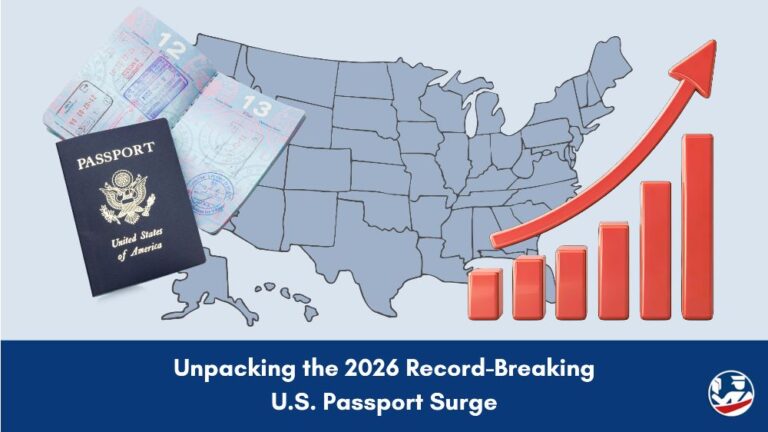
For decades, the U.S. passport was the gold standard of travel documents. However, as we enter 2026, global mobility has officially shifted.
For the first time in 20 years, the United States has dropped out of the global Top 10, currently sitting at 12th place on the Henley Passport Index.
While the U.S. passport still offers access to 180 destinations, it is now tied with Malaysia and sits behind nations like Singapore (#1), Japan and South Korea (#2), and several European powers (#3).
For U.S. travelers, this drop is more than just a number; it represents a new era of “reciprocity.”
Understanding “Reciprocity” and Passport Power
In the world of international travel, a passport’s power is directly tied to the concept of reciprocity. At its simplest, reciprocity is a “tit-for-tat” or retaliatory diplomatic agreement. If Country A allows citizens of Country B to enter without a visa, Country B is expected to offer the same privilege in return.
When this balance is lost, it can lead to a decline in passport strength. For example, the U.S. currently allows visa-free entry to citizens of only 46 nations, yet Americans enjoy visa-free access to 180 destinations. This wide reciprocity gap has prompted countries like Brazil to reinstate visa requirements for U.S. travelers in 2025, directly contributing to the U.S. passport’s slide in global rankings.
For U.S. travelers, a drop in passport power means more pre-travel paperwork, new government fees, and longer wait times for entry.
The 2026 Reciprocity Watchlist
As we move through 2026, several nations are closely monitoring the U.S. visa policy. If the U.S. does not expand its own visa-waiver program, these countries are the most likely to introduce new limits for American travelers:
- Brazil (Immediate Action Required): The eVisa requirement is now fully in effect. If you are traveling to Rio or São Paulo in 2026, you must apply at least 2 months in advance.
- Israel (ETA-IL): Israel has moved to a mandatory ETA-IL system for 2026. While technically visa-free for Americans, there is now a small fee and a mandatory 72-hour pre-approval window.
- The European Union (ETIAS): While the U.S. and EU have a long-standing “visa-free” relationship, the lack of reciprocity for some EU member states (e.g., Bulgaria and Romania) in the U.S. program is a primary driver behind the launch of the ETIAS requirement for Americans in late 2026.
The 2026 “Digital Barrier”: ETAs and ETIAS
The biggest change for U.S. travelers in 2026 isn’t the need for traditional paper visas, but the rise of Digital Travel Authorizations.
Even in countries technically “visa-free,” Americans now face mandatory pre-travel screening:
1. The UK ETA (Electronic Travel Authorisation)
Since early 2025, U.S. citizens must have an approved ETA to enter any part of the United Kingdom.
- Cost: £10 (~$13)
- Requirement: Must be secured before arriving at the airport. Airlines will deny boarding without it.
2. The EU ETIAS
Launching in late 2026, ETIAS will be mandatory for all U.S. citizens visiting the Schengen Zone (including France, Italy, and Spain). This coincides with the new Entry/Exit System (EES), which replaces physical ink stamps with fingerprint and facial scans.
Quick Summary: The New Rules of Travel
In 2026, the concept of a “strong” passport has evolved. It is no longer just about which countries allow you to enter without a visa; it is about how easily you can navigate the new digital infrastructure that many nations have built to manage their borders.
Here is a breakdown of what that means and how to avoid travel disruptions:
1. The Shift from “Paper” to “Digital”
For decades, passport power was simple. If your country had a good relationship with another, you just showed up at the border and got a stamp.
In 2026, most “visa-free” destinations have replaced that simple process with Digital Travel Authorizations. Even though you don’t need a formal visa, you must now “activate” your passport’s power by applying for digital permission before you even leave home.
2. Navigating Digital Systems
When we say strength is measured by your ability to navigate these systems, we mean that a traveler’s success depends on three digital factors:
- Pre-Travel Approval: Applying for systems like ETIAS (for Europe) or UK ETA (for the United Kingdom) at least 72 hours before travel.
- Biometric Enrollment: Participating in systems like the EU’s Entry/Exit System (EES), which scans your fingerprints and face rather than stamping your passport.
- Electronic Linking: Ensuring your digital permit is correctly “linked” to your specific passport number in the airline’s database. If these don’t match, the system will prevent you from boarding your flight.
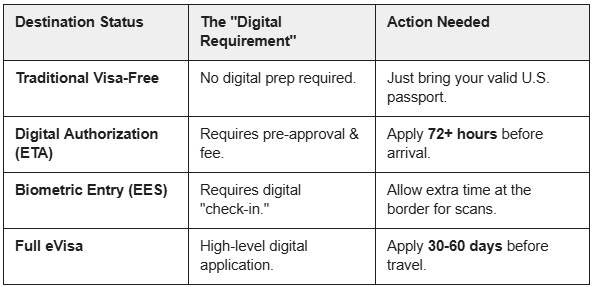
3. Using the Status Guide to Avoid Disruptions
Today, different countries use different digital systems, which means you can no longer treat every “visa-free” country the same way.
The guide helps you categorize your destination so you know exactly which digital system to navigate:
In 2026, a “powerful” passport is only powerful if you have completed the digital steps required to use it. Without the correct digital authorization, even the world’s highest-ranked passport can be “weakened” to the point where you are denied entry.
Safe travels,
Laura